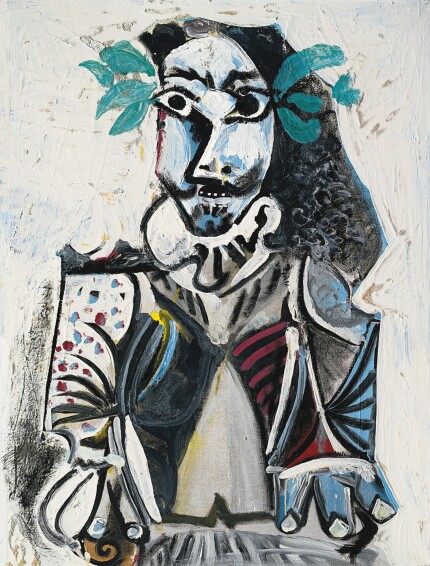

Pablo Picasso
Buste d'homme lauré , 1969 (Painted)
Lot #1031 |
2018-09-30 |
Sotheby's, Hong Kong
Modern Art Evening Sale
Category:
Painting
Estimate:
HKD 50,000,000 - 70,000,000 (currency of sale)
USD 6,410,000 - 8,974,000 (approx.)
Price Sold:
Auction Details
Auction house: Sotheby's
Auction number: HK0809
Auction name: Modern Art Evening Sale
Auction type: Fine Art
Location: Hong Kong
Start date: 2018-09-30
Currency: HKD
Source:
Login to view
Lot Description
Details
Genre: 20th Century Spanish Art
Department: Painting & Works on Paper
Medium: Login to view
Dimensions: 116 by 89 cm
Item measurements:
Height In Centimeters:
116
Width In Centimeters:
89
Height In Inches:
45.625
Width In Inches:
35
Signed: Login to view
Year notes: Painted in 1969.
Provenance
Estate of the artist Collection of Bernard Ruiz Picasso, Paris Collection Heinz Berggruen Acquired from the above by the present important private European collector
Exhibited
Avignon, Palais des Papes, Pablo Picasso: 1969-1970 , 1970, no. 32, illustrated in the catalogue New York, The Pace Gallery, Picasso: The Avignon Paintings, 1981, illustrated in the catalogue Kunstmuseum Basel, Pablo Picasso, Das Spätwerk , 1981, no. 38, illustrated in colour in the catalogue Gisors, Mairie de Gisors, Picasso, 1983 Vienna, Kunstforum & Tubingen, Kunsthalle, Picasso: Figur und Portrait, Hauptwerke aud der Sammlung Bernard Picasso , 2002, no. 88, illustrated in the catalogue Nantes, Musée des Beaux Arts de Nantes & Padua, Palazzo Zabarella, Picasso: 1961-1972 , 2001-2003, no. 30 in Nantes & no. 31 in Padua, illustrated in the catalogue Copenhagen, Arken Museum for Moderne Kunst, Picasso: For All Times, 2004, no. 35, illustrated in the catalogue Malaga, Museo Picasso, Picasso: Anthology 1895-1971, 2004-05, no. 124, illustrated in the catalogue Istanbul, Sakıp Sabancı Museum, Sabancı Üniversitesi, Picasso in Istanbul , 2005-06, no. 128, illustrated in colour in the catalogue
Literature
Rafael Alberti, A Year of Picasso Paintings: 1969 , H.N. Abrams, New York, 1971, no. 180, illustrated in colour n.p. Christian Zervos, Pablo Picasso, oeuvres de 1969 , Cahiers d'art, Paris, 1976, vol. 31, no. 194, illustrated p. 63 The Picasso Project, ed., Picasso's Paintings, Watercolours, Drawings and Sculpture, The Sixties III, 1968-1969 , Alan Wofsy Fine Art, San Francisco, 2003, no. 69-197, illustrated p. 161 Condition The work is overall in good condition. A tiny paint loss at the lower left corner of the canvas is visible only upon close inspection. Condition report from an external party is available upon request. "In response to your inquiry, we are pleased to provide you with a general report of the condition of the property described above. Since we are not professional conservators or restorers, we urge you to consult with a restorer or conservator of your choice who will be better able to provide a detailed, professional report. Prospective buyers should inspect each lot to satisfy themselves as to condition and must understand that any statement made by Sotheby's is merely a subjective, qualified opinion. Prospective buyers should also refer to any Important Notices regarding this sale, which are printed in the Sale Catalogue. NOTWITHSTANDING THIS REPORT OR ANY DISCUSSIONS CONCERNING A LOT, ALL LOTS ARE OFFERED AND SOLD AS IS" IN ACCORDANCE WITH THE CONDITIONS OF BUSINESS PRINTED IN THE SALE CATALOGUE." Catalogue Note The vibrant Buste d’homme lauré ( Lot 1031 )is a powerful example of a theme that was central to Picasso in the last years of his life. The work was painted during Picasso’s most prolific year, 1969, during which he seemed to not at all be affected by his advanced age but rather invigorated by his vast experience. These works were
Catalog summary
Pablo Picasso Buste d'homme lauré dated 11.5.69 on the reverse oil on canvas 116 by 89 cm; 45 ⅝ by 35 in. painted in 1969 Provenance Estate of the artist Collection of Bernard Ruiz Picasso, Paris Collection Heinz Berggruen Acquired from the above by the present important private European collector Exhibited Avignon, Palais des Papes, Pablo Picasso: 1969-1970 , 1970, no. 32, illustrated in the catalogue New York, The Pace Gallery, Picasso: The Avignon Paintings, 1981, illustrated in the catalogue Kunstmuseum Basel, Pablo Picasso, Das Spätwerk , 1981, no. 38, illustrated in colour in the catalogue Gisors, Mairie de Gisors, Picasso, 1983 Vienna, Kunstforum & Tubingen, Kunsthalle, Picasso: Figur und Portrait, Hauptwerke aud der Sammlung Bernard Picasso , 2002, no. 88, illustrated in the catalogue Nantes, Musée des Beaux Arts de Nantes & Padua, Palazzo Zabarella, Picasso: 1961-1972 , 2001-2003, no. 30 in Nantes & no. 31 in Padua, illustrated in the catalogue Copenhagen, Arken Museum for Moderne Kunst, Picasso: For All Times, 2004, no. 35, illustrated in the catalogue Malaga, Museo Picasso, Picasso: Anthology 1895-1971, 2004-05, no. 124, illustrated in the catalogue Istanbul, Sakıp Sabancı Museum, Sabancı Üniversitesi, Picasso in Istanbul , 2005-06, no. 128, illustrated in colour in the catalogue Literature Rafael Alberti, A Year of Picasso Paintings: 1969 , H.N. Abrams, New York, 1971, no. 180, illustrated in colour n.p. Christian Zervos, Pablo Picasso, oeuvres de 1969 , Cahiers d'art, Paris, 1976, vol. 31, no. 194, illustrated p. 63 The Picasso Project, ed., Picasso's Paintings, Watercolours, Drawings and Sculpture, The Sixties III, 1968-1969 , Alan Wofsy Fine Art, San Francisco, 2003, no. 69-197, illustrated p. 161 Condition The work is overall in good condition. A tiny paint loss at the lower left corner of the canvas is visible only upon close inspection. Condition report from an external party is available upon request. "In response to your inquiry, we are pleased to provide you with a general report of the condition of the property described above. Since we are not professional conservators or restorers, we urge you to consult with a restorer or conservator of your choice who will be better able to provide a detailed, professional report. Prospective buyers should inspect each lot to satisfy themselves as to condition and must understand that any statement made by Sotheby's is merely a subjective, qualified opinion. Prospective buyers should also refer to any Important Notices regarding this sale, which are printed in the Sale Catalogue. NOTWITHSTANDING THIS REPORT OR ANY DISCUSSIONS CONCERNING A LOT, ALL LOTS ARE OFFERED AND SOLD AS IS" IN ACCORDANCE WITH THE CONDITIONS OF BUSINESS PRINTED IN THE SALE CATALOGUE." Catalogue Note The vibrant Buste d’homme lauré ( Lot 1031 )is a powerful example of a theme that was central to Picasso in the last years of his life. The work was painted during Picasso’s most prolific year, 1969, during which he seemed to not at all be affected by his advanced age but rather invigorated by his vast experience. These works were exhibited in a dedicated show the following year in 1970, organized by Christian Zervos, which opened at the Palais des Papes in Avignon. The large canvases were displayed one on top of another in the hall of Clement IV, taking full advantage of the high-vaulted ceilings in the Gothic venue. For Picasso, the musketeer signified the golden age of painting, and allowed him to escape the limitations of contemporary subject matter and explore the spirit of a past age. Picasso’s inspiration for this figure and other masculine warriors of his late paintings can be traced to his Spanish childhood and his familiarity with Cervantes’ Don Quixote. The musketeer was a character that embodied the courtly mannerisms of the Renaissance gentleman, and Picasso now resurrected him for a twentieth-century audience. The artist’s rendering of this image was also his tribute to the work of two painters he had adored throughout his life: Diego Velázquez, whose portraits of seventeenth-century Spanish nobility and monarchs were clear sources of inspiration for the present picture, and the Dutch master, Rembrandt van Rijn, whom Jacqueline Roque credited as being a key influence on Picasso’s art of this period. It was through these reinterpretations and investigations of the Old Masters that Picasso reaffirmed his connection to some of the greatest painters in the history of art. Brigitte Léal has considered what it meant for Picasso to be painting these historical characters in the late 20th century. She considers the cultural significance of the musketeer: "It was not without humor that Picasso created these characters, whose amorous adventures he chronicled in his etchings. Imagine painting musketeers in 1970! They were ornamental figures whose clothes were a pretext both for the blaze of blood red and golden yellow and for the resurgence of a newly found Spanishness" (Brigitte Léal, Christine Piot, Marie-Laure Bernadac, The Ultimate Picasso, New York, 2000, p. 458). The present work is differentiated from other portraits of 1969 by the addition of a laurel wreath to the musketeer. Seldom used within his œuvre, the laurel wreath traditionally denotes a personal triumph.