

Ivan Chuikov
Windows
Lot #315 |
2021-12-01 |
Sotheby's, London
Post-War and Contemporary Russian Art from a Private Collection
Category:
Decorative Art
Estimate:
GBP 60,000 - 80,000 (currency of sale)
USD 82,560 - 110,080 (approx.)
Price Sold:
Auction Details
Auction house: Sotheby's
Auction number: L21118
Auction name: Post-War and Contemporary Russian Art from a Private Collection
Auction type: Fine Art
Location: London
Start date: 2021-12-01
Currency: GBP
Source:
Login to view
Lot Description
Details
Genre: 20th Century Russian Art
Department: Decorative & Applied Arts
Medium: Login to view
Dimensions: 78 by 44.5cm
Item measurements:
Height In Centimeters:
78
Width In Centimeters:
44.5
Height In Inches:
30.709
Width In Inches:
17.52
Height In Centimeters:
86
Width In Centimeters:
48
Height In Inches:
33.858
Width In Inches:
18.898
Height In Centimeters:
94.5
Width In Centimeters:
52
Height In Inches:
37.205
Width In Inches:
20.472
Signed: Login to view
Provenance
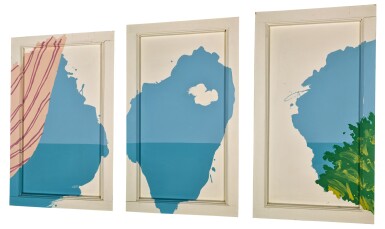
Private collection, Europe, acquired directly from the artist Sotheby's London, Russian Contemporary Art , 12 March 2008, lot 33 Catalogue note The motif of the window, first used by Chuikov in 1967, is central to the artist’s oeuvre. As the art critic Evgeny Barabanov notes, the window ‘…is a dialogue with the Renaissance idea of ‘painting as a window into the world’, but this dialogue immediately reveals a failure with far-reaching consequences: Chuikov takes this Renaissance metaphor seriously; he treats the window not only as a symbol, a sign, an image or a notion – he interprets it literally as a material structure […] The frame replaces the traditional canvas and stretcher for the artist. Yet behind the relief of this frame the viewer’s eye immediately discovers the flat ‘bottom’ of the stage scenery painted in a simplified manner. Instead of any movement in the direction of its depth [...] the viewer is presented with a greatly reduced depiction: a crudely painted surface [...] sometimes spreading beyond its limits. [...] Chuikov’s Windows are easily transformed into parables about the fate of our culture, existentially charged metaphors of social exclusion, isolation, lack of freedom’ (E.Barabanov, quoted in Ivan Chuikov , Moscow: Regina Gallery, 2010, p.198).
Catalog summary
Property from a Private European Collection Ivan Chuikov 1935 - 2020 Windows each part signed in Cyrillic and dated 82 on the reverse; the right part bearing a Soviet export stamp on the reverse enamel paint on wood and masonite left part: 78 by 44.5cm, 30¾ by 17½in.; central part: 86 by 48cm, 34 by 19in.; right part: 94.5 by 52cm, 37¼ by 20½in. (3) Provenance Private collection, Europe, acquired directly from the artist Sotheby's London, Russian Contemporary Art , 12 March 2008, lot 33 Catalogue note The motif of the window, first used by Chuikov in 1967, is central to the artist’s oeuvre. As the art critic Evgeny Barabanov notes, the window ‘…is a dialogue with the Renaissance idea of ‘painting as a window into the world’, but this dialogue immediately reveals a failure with far-reaching consequences: Chuikov takes this Renaissance metaphor seriously; he treats the window not only as a symbol, a sign, an image or a notion – he interprets it literally as a material structure […] The frame replaces the traditional canvas and stretcher for the artist. Yet behind the relief of this frame the viewer’s eye immediately discovers the flat ‘bottom’ of the stage scenery painted in a simplified manner. Instead of any movement in the direction of its depth [...] the viewer is presented with a greatly reduced depiction: a crudely painted surface [...] sometimes spreading beyond its limits. [...] Chuikov’s Windows are easily transformed into parables about the fate of our culture, existentially charged metaphors of social exclusion, isolation, lack of freedom’ (E.Barabanov, quoted in Ivan Chuikov , Moscow: Regina Gallery, 2010, p.198).