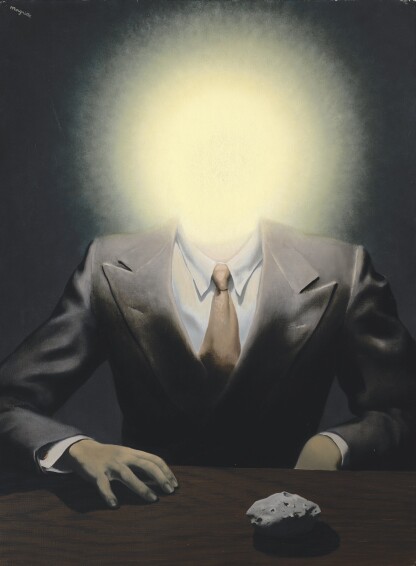

René Magritte
Le Principe du plaisir , 1937 (Dated)
Lot #35 |
2018-11-12 |
Sotheby's, New York
Impressionist & Modern Art Evening Sale
Category:
Painting
Estimate:
USD 15,000,000 - 20,000,000 (currency of sale)
Price Sold:
Auction Details
Auction house: Sotheby's
Auction number: N09930
Auction name: Impressionist & Modern Art Evening Sale
Auction type: Fine Art
Location: New York
Start date: 2018-11-12
Currency: USD
Source:
Login to view
Lot Description
Details
Genre: 20th Century Scottish Art
Department: Painting & Works on Paper
Medium: Login to view
Dimensions: 3/4 by 21 1/2 in.
Item measurements:
Height In Centimeters:
73
Width In Centimeters:
54.5
Height In Inches:
28.75
Width In Inches:
21.5
Markings: Login to view
Signed: Login to view
Edition: 4
Edition notes: Edition 3/4.
Year notes: Dated in 1937.
Provenance
Edward James, United Kingdom (acquired from the artist circa 1937) Edward James Foundation, United Kingdom (acquired from the above circa 1964 and sold: Sotheby's, London, June 28, 1978, lot 45) Private Collection, Switzerland (acquired at the above sale) Acquired from the above in 1979
Exhibited
London, The London Gallery, René Magritte, Surrealist Paintings and Objects , 1938, no. 40 Worthing, Municipal Art Gallery, Surrealists from the Edward James Collection , 1963, no. 32 Brighton, Art Gallery, Thirty Years of Surrealist Paintings from the Edward James Collection , 1967, no. 41 Durham, Dunelm House, Surrealist Festival , 1968, no. 12 London, Tate Gallery, Magritte , 1969, no. 55, illustrated in the catalogue London, Marlborough Fine Art, Magritte, Retrospective Loan Exhibition , 1973, no. 33, illustrated in the catalogue Liverpool, Tate Liverpool & Vienna, Albertina, The Pleasure Principle , 2011-12, n.n., illustrated in color in the catalogue New York, The Museum of Modern Art; Houston, The Menil Collection & Chicago, The Art Institute of Chicago, Magritte: The Mystery of the Ordinary, 1926-1938 , 2013-14, no. 124, illustrated in color in the catalogue
Literature
Suzi Gablik, Magritte , London, 1970, no. 141, illustrated in color n.p & on the cover Abraham M. Hammacher, René Magritte , New York, 1973, illustrated p. 39 Alain Robbe-Grilley & René Magritte, La Belle captive , Brussels, 1975, illustrated p. 106 Rétrospective Magritte (exhibition catalogue), Palais des Beaux-Arts, Brussels & Musée national d'art moderne, Centre national d'art et de culture Georges Pompidou, 1978-79, illustrated pp. 30 & 50 Tages-Anzeiger , Zurich, February 10, 1979, illustrated in color on the cover Suzi Gablik, Magritte , London, 1985, no. 178, illustrated in color p. 156 Jacques Meuris, Magritte , Paris, 1988, illustrated p. 205 David Sylvester, Magritte, The Silence of the World , New York, 1992, illustrated in color p. 244 David Sylvester & Sarah Whitfield, eds., René Magritte, Catalogue raisonné , vol. II, London, 1993, no. 443, illustrated p. 249 A Surreal Life: Edward James 1907-1984 (exhibition catalogue), Brighton Museum & Art Gallery, Brighton, 1998, illustrated p. 39 Patrick Roegiers, Magritte et la photographie , London, 2005, illustrated in color p. 108 Magritte tout en papier (exhibition catalogue), Musée Maillol, Paris, 2006, illustrated in color p. 118 René Magritte, l'impero delle luci (exhibition catalogue), Villa Olmo, Como, 2006, illustrated in color p. 36 Surreal Encounters: Collecting the Marvellous. Works from the Collections of Roland Penrose, Edward James, Gabrielle Keiller and Ulla and Heiner Pietzsch (exhibition catalogue), Scottish National Gallery of Modern Art, Edinburgh; Kunsthalle, Hamburg & Museum Boijmans Van Beuningen, Rotterdam, 2016-17, illustrated in color p. 200 Catalogue Note Le Principe du plaisir (The Pleasure Principle) , painted in 1937, showcases several enduring and recognizable themes from Magritte’s oeuvre: visual and cerebral paradox, an uncanny alteration of the familiar and the tension between the visible and the hidden. The painting is a portrait of Edward James, an English heir to an American railroad fortune turned eccentric poet and influential patron of Surrealist art. After Dalí introduced James to Magritte in 1937, James immediately invited the artist to spend the winter months at his Wimpole Street house in London, and for two years James commissioned a number of paintings from the burgeoning Surrealist. Of these commissions, two are portraits of the patron: La Reproduction interdite ( Not To Be Reproduced ) and the present work.Magritte envisioned the concept for Le Principe du plaisir before ever meeting James. In 1936 Magritte included an ink sketch resembling the present work on the first page of a hand-made book honoring the surrealist poet, Paul Éluard. Beneath the drawing, Magritte writes “pour Paul Éluard (Idée de Paul Colinet)." This inscription may refer to Marcel Mariën’s claim that Paul Colinet submitted the idea for portrait manqué ( failed portrait ), or a portrait with an invisible or hidden face, to Magritte, albeit after the artist had been obscuring the likeness of his subjects for nearly a decade. Then, in June 1937, several months after his stay at James’ Wimpole Street home, Magritte presented the idea of this portrait in a letter to James: “I have done a picture representing a man whose head is a light…I consider it as a preliminary study, the real picture as I envision is still to be painted but since it would be intended for you, do you not think your person could be recognized in it as well? If the idea appeals to you, all you have to do is be photographed full-faced at a table with your arms crossed and resting on the table and a sort of stone lying on the table to your right and not too far from your arm. And send me the photograph” (quoted in D. Sylvester, ed., René Magritte Catalogue Raisonné, op. cit. , pp. 249-50). James commissioned fellow surrealist Man Ray to take his photograph, which he quickly mailed to Magritte for the portrait. When Magritte finished the painting in September and had it delivered to James in London, James told Magritte in a letter, “My friend and I think it is a great success, in fact a work of genius” (quoted in ibid ., p. 250). Le Principe du plaisir exemplifies Magritte’s interest with what is hidden in our visual reality. Throughout his career, Magritte employs surrealist imagery that confronts our fascination with the hidden—hidden faces in particular. An apple conceals the face of his iconic bowler hat man in Le Fils de l'homme while white clothes cover the faces of his subject in Les Amant s . In one of his few recorded interviews (Magritte detested publicity and discussions of his own work), Magritte relates that, “Everything we see hides another thing; we always want to see what is hidden by what we see. There is an interest in that which is hidden and which the visible doesn’t show us. This interest can take the form of a quite intense feeling, a sort of conflict, one might say between the visible that is hidden and the visible that is apparent” (quoted in D. Sylvester, Magritte: The Silence of the World , 1992, New York, p. 24). Magritte achieves this conflict in Le Principe du plaisir with a characteristic twist of paradox: we expect, and need, light to reveal, not conceal, the subject’s face in an otherwise dark room, just as we expect the mirror to reveal, not conceal, the subject’s face in La Reproduction interdite . The title of the painting refers to a key element of Freudian psychoanalysis, which served as a philosophical underpinning for the Surrealist movement. However, Magritte himself has warned against interpretations and analysis of his titles: “The titles of pictures are not explanations and pictures are not illustrations of titles. The relationship between title and picture is poetic, that is, it only catches some of the object’s characteristics of which we are usually unconscious, but which we sometimes intuit, when extraordinary events take place which logic has not yet managed to elucidate” (quoted in J. Levy, ed., René Magritte: Selected Writings , Minneapolis, 2016, p. 112). Edward James, a poet and a lifelong collector of art, is particularly remembered for his patronage of Surrealist painters including Dalí, Margritte, Tchelitchew, Fini and Carrington. He provided space for his artist friends to develop their creative practice. Dalí, Tchelitchew, Magritte and others were given studio space during extended stays in Edward's homes at West Dean and in London. He supported them further through commissions and collaborations, building one of the finest collections of Surrealist art in the world. Le Principe du plaisir remained in James' collection until 1964 when it became a part of his eponymous Foundation. It was acquired by the present owner in 1979 and has remained in the same private collection for nearly forty years.
Catalog summary
René Magritte Le Principe du plaisir Signed magritte (upper left); titled "Le Principe du plaisir," signed Magritte and dated 1937 (on the reverse) Oil on canvas 28 3/4 by 21 1/2 in. 73 by 54.5 cm Painted in 1937. Provenance Edward James, United Kingdom (acquired from the artist circa 1937) Edward James Foundation, United Kingdom (acquired from the above circa 1964 and sold: Sotheby's, London, June 28, 1978, lot 45) Private Collection, Switzerland (acquired at the above sale) Acquired from the above in 1979 Exhibited London, The London Gallery, René Magritte, Surrealist Paintings and Objects , 1938, no. 40 Worthing, Municipal Art Gallery, Surrealists from the Edward James Collection , 1963, no. 32 Brighton, Art Gallery, Thirty Years of Surrealist Paintings from the Edward James Collection , 1967, no. 41 Durham, Dunelm House, Surrealist Festival , 1968, no. 12 London, Tate Gallery, Magritte , 1969, no. 55, illustrated in the catalogue London, Marlborough Fine Art, Magritte, Retrospective Loan Exhibition , 1973, no. 33, illustrated in the catalogue Liverpool, Tate Liverpool & Vienna, Albertina, The Pleasure Principle , 2011-12, n.n., illustrated in color in the catalogue New York, The Museum of Modern Art; Houston, The Menil Collection & Chicago, The Art Institute of Chicago, Magritte: The Mystery of the Ordinary, 1926-1938 , 2013-14, no. 124, illustrated in color in the catalogue Literature Suzi Gablik, Magritte , London, 1970, no. 141, illustrated in color n.p & on the cover Abraham M. Hammacher, René Magritte , New York, 1973, illustrated p. 39 Alain Robbe-Grilley & René Magritte, La Belle captive , Brussels, 1975, illustrated p. 106 Rétrospective Magritte (exhibition catalogue), Palais des Beaux-Arts, Brussels & Musée national d'art moderne, Centre national d'art et de culture Georges Pompidou, 1978-79, illustrated pp. 30 & 50 Tages-Anzeiger , Zurich, February 10, 1979, illustrated in color on the cover Suzi Gablik, Magritte , London, 1985, no. 178, illustrated in color p. 156 Jacques Meuris, Magritte , Paris, 1988, illustrated p. 205 David Sylvester, Magritte, The Silence of the World , New York, 1992, illustrated in color p. 244 David Sylvester & Sarah Whitfield, eds., René Magritte, Catalogue raisonné , vol. II, London, 1993, no. 443, illustrated p. 249 A Surreal Life: Edward James 1907-1984 (exhibition catalogue), Brighton Museum & Art Gallery, Brighton, 1998, illustrated p. 39 Patrick Roegiers, Magritte et la photographie , London, 2005, illustrated in color p. 108 Magritte tout en papier (exhibition catalogue), Musée Maillol, Paris, 2006, illustrated in color p. 118 René Magritte, l'impero delle luci (exhibition catalogue), Villa Olmo, Como, 2006, illustrated in color p. 36 Surreal Encounters: Collecting the Marvellous. Works from the Collections of Roland Penrose, Edward James, Gabrielle Keiller and Ulla and Heiner Pietzsch (exhibition catalogue), Scottish National Gallery of Modern Art, Edinburgh; Kunsthalle, Hamburg & Museum Boijmans Van Beuningen, Rotterdam, 2016-17, illustrated in color p. 200 Catalogue Note Le Principe du plaisir (The Pleasure Principle) , painted in 1937, showcases several enduring and recognizable themes from Magritte’s oeuvre: visual and cerebral paradox, an uncanny alteration of the familiar and the tension between the visible and the hidden. The painting is a portrait of Edward James, an English heir to an American railroad fortune turned eccentric poet and influential patron of Surrealist art. After Dalí introduced James to Magritte in 1937, James immediately invited the artist to spend the winter months at his Wimpole Street house in London, and for two years James commissioned a number of paintings from the burgeoning Surrealist. Of these commissions, two are portraits of the patron: La Reproduction interdite ( Not To Be Reproduced ) and the present work.Magritte envisioned the concept for Le Principe du plaisir before ever meeting James. In 1936 Magritte included an ink sketch resembling the present work on the first page of a hand-made book honoring the surrealist poet, Paul Éluard. Beneath the drawing, Magritte writes “pour Paul Éluard (Idée de Paul Colinet)." This inscription may refer to Marcel Mariën’s claim that Paul Colinet submitted the idea for portrait manqué ( failed portrait ), or a portrait with an invisible or hidden face, to Magritte, albeit after the artist had been obscuring the likeness of his subjects for nearly a decade. Then, in June 1937, several months after his stay at James’ Wimpole Street home, Magritte presented the idea of this portrait in a letter to James: “I have done a picture representing a man whose head is a light…I consider it as a preliminary study, the real picture as I envision is still to be painted but since it would be intended for you, do you not think your person could be recognized in it as well? If the idea appeals to you, all you have to do is be photographed full-faced at a table with your arms crossed and resting on the table and a sort of stone lying on the table to your right and not too far from your arm. And send me the photograph” (quoted in D. Sylvester, ed., René Magritte Catalogue Raisonné, op. cit. , pp. 249-50). James commissioned fellow surrealist Man Ray to take his photograph, which he quickly mailed to Magritte for the portrait. When Magritte finished the painting in September and had it delivered to James in London, James told Magritte in a letter, “My friend and I think it is a great success, in fact a work of genius” (quoted in ibid ., p. 250). Le Principe du plaisir exemplifies Magritte’s interest with what is hidden in our visual reality. Throughout his career, Magritte employs surrealist imagery that confronts our fascination with the hidden—hidden faces in particular. An apple conceals the face of his iconic bowler hat man in Le Fils de l'homme while white clothes cover the faces of his subject in Les Amant s . In one of his few recorded interviews (Magritte detested publicity and discussions of his own work), Magritte relates that, “Everything we see hides another thing; we always want to see what is hidden by what we see. There is an interest in that which is hidden and which the visible doesn’t show us. This interest can take the form of a quite intense feeling, a sort of conflict, one might say between the visible that is hidden and the visible that is apparent” (quoted in D. Sylvester, Magritte: The Silence of the World , 1992, New York, p. 24). Magritte achieves this conflict in Le Principe du plaisir with a characteristic twist of paradox: we expect, and need, light to reveal, not conceal, the subject’s face in an otherwise dark room, just as we expect the mirror to reveal, not conceal, the subject’s face in La Reproduction interdite . The title of the painting refers to a key element of Freudian psychoanalysis, which served as a philosophical underpinning for the Surrealist movement. However, Magritte himself has warned against interpretations and analysis of his titles: “The titles of pictures are not explanations and pictures are not illustrations of titles. The relationship between title and picture is poetic, that is, it only catches some of the object’s characteristics of which we are usually unconscious, but which we sometimes intuit, when extraordinary events take place which logic has not yet managed to elucidate” (quoted in J. Levy, ed., René Magritte: Selected Writings , Minneapolis, 2016, p. 112). Edward James, a poet and a lifelong collector of art, is particularly remembered for his patronage of Surrealist painters including Dalí, Margritte, Tchelitchew, Fini and Carrington. He provided space for his artist friends to develop their creative practice. Dalí, Tchelitchew, Magritte and others were given studio space during extended stays in Edward's homes at West Dean and in London. He supported them further through commissions and collaborations, building one of the finest collections of Surrealist art in the world. Le Principe du plaisir remained in James' collection until 1964 when it became a part of his eponymous Foundation. It was acquired by the present owner in 1979 and has remained in the same private collection for nearly forty years.